WASTE


Kasetsart University has formulated a clear policy for good environmental management. The objective and principle were to be a green university as an example for students and personnel to be implemented and applied to the family and community. Therefore, the university has developed a system for efficient waste collection and management as a way to preserve the environment. For example, recycling waste, reducing the use of natural resources, reusing food waste to make bio-compost for plants to restore integrity back to nature. This practices applying within the university cause a positive effect on the environment according to the determined objectives and goals of the university. The waste recycling campaign is managed to encourage all departments to participate in waste reduction, waste separation and waste recycling. A campaign to reduce the use of paper and plastic is promoted to save paper within Kasetsart University. The campaign to use fabric bags instead of plastic bags created from the awareness of stable and sustainable environmental conservation and the problem of global warming, which is mainly caused by plastic waste. Organic waste treatment and composting organic waste are also transforming and adding value to waste and burden. Inorganic waste treatment by managing inorganic waste in different areas is to reduce the amount of waste that will be taken to landfill. Toxic waste management, collection and storage is to ensure safety. Also, during the situation of PM 3.5 dust, the university has handled the problem by spraying water to reduce the amount of dust, installing air treatment machines and setting up stations to measure daily air quality. During the spread of Covid-19 coronavirus disease, Kasetsart University has added infectious waste bins to be used to dispose of sanitary residue at various points and places. For the 2020 commencement ceremony, Kasetsart University has applied a measure for graduates who attend the graduation ceremony to wear medical masks for safety in the incidence of Covid-19. Wastewater management and water quality treatment are implemented through the treatment process, then be reused in some activities to reduce the cost of tap water bill and the contamination of the wastewater before disposing into the environment.
3.3 Disposal of Organic solid waste

3.3.1 Black soldier fly.
The students of Environmental Engineering for Sustainable Development, the Faculty of Science and Engineering, and the advisory team followed up on the farming of black soldier fly to be used in high-protein chicken feed production implemented in 15 households under the Youth Volunteer Project in Rong Kham District, Kalasin Province. The performance was very satisfactory. At the household level, each farm can produce 1-2 kilograms per day of the black soldier fly larvae and can reduce 1-2 kilograms of organic solid waste per day. Based on that trend, the farmers will be also able to reduce the cost of buying ready-made chicken feed.
Public service. This is to transfer knowledge and solutions for disposing of a large volume of organic solid waste. Black soldier fly helps simply manage household organic solid waste and it is a model for organic solid waste management at the household level. Black soldier fly help decompose organic solid waste in a household. It is safe to use it to digest organic solid waste and to produce animal feed that is beneficial for the community members. Besides waste reduction, it also helps save a cost for purchasing fertilizer.
Agricultural innovation. The Black Soldier Fly Project helps dispose of organic solid waste at its source. It was also found that the larvae of black soldier fly plays an important role in decomposing food waste, moist waste, and animal feces as well as rotting wood. The university has transferred the knowledge to communities nearby the university to apply it for their waste disposal in the communities. The larvae can help digest organic solid waste quickly. Thus, this is a great way to mitigate the environmental problems and to convert organic solid waste into rich-nutrient compost that plants need. This project also helps promote the use of technology to disseminate knowledge on the black soldier fly larvae which is fast and easy to understand along with the implementing marketing.
Socials engagement. The university has transferred the knowledge to the communities nearby the university in order to apply it for the community’s waste disposal and gain more income. When food waste is being decomposed by black soldier fly, methane is not released because the larvae convert the carbons in the waste into proteins while only a small amount of carbon dioxide is released. Kasetsart University, in collaboration with the Center for Organic Solid Waste Management using Black soldier Fly of Ban Non Sala Community, Chiang Khruea Sub-district, Muang Sakon Nakhon District, Sakon Nakhon Province, established a learning center for applying the black soldier fly larvae in a household organic solid waste disposal. It is also a learning center for farming the black soldier fly larvae throughout its life cycle to produce high-protein animal feed. The eggs and breeders of black soldier fly are available for sales as well as a manual for black soldier fly farming. For those who are interested can contact the center to learn and ask for more information at the Facebook page of the Products of Black Soldier Fly Larvae, Ban Non Sala.
3.3.2 Utilization of weeds using a weed chipper.
Agricultural innovation. The weed chipper is an agricultural innovation developed by the university helping neighboring farmers to resolve high-volume weed problems by turning the useless weeds into valuable things.
Socials engagement. Kasetsart University has transferred knowledge to the communities by demonstrating the use of a weed chipper and making compos. This not only solves the households and communities’ problems but also generates more income for the communities as well

3.3.3 Biogas and Liquid Fertilizer Production Project.
It is an organic solid waste management project to dispose of food waste generated from canteens and various faculties within the university. It has been promoted as a learning and research center for students and staff as well as applying it to plant and soil nourishment.
3.3.4 Fertilizers Project.
Compost for Beautiful Garden Project The project helps reduce organic solid waste, particularly twigs and leaves which are composed. The compost is further used for nourishing soil and plants in the university.
Kasetsart University has created the production of high-quality compost with less production time. The compost made from animal feces, namely chicken, pig, and cow feces mixed with husk has a higher content of nitrogen and phosphorus than that made from leaves. The leaf compost has less concentration of minerals and it is not suitable for nourishing organic plants. Making the compost without turning a pile uses only dry animal feces kept at room temperature of 25-30 degrees Celsius. It is mixed in the mixing chamber and stored in a well-ventilated fertilizer bag for fifteen days before using it.


Previous
Next

3.3.5 Production of good-quality fermented feed from Kasetsart University’s farm for farmers Kasetsart University Chaloem Phra Kiat Campus, Sakon Nakhon Province, in collaboration with the Sakon Nakhon Animal Feed Research and Development Center, Department of Livestock Development, organized a workshop on the project “Production of good-quality fermented food from Kasetsart University’s farm for farmers” on August 13 – 14, 2020.
Assistant Professor Dr. Sittichai Hatachote, associate president on Research, Innovation and Academic Services, delivered his opening speech for the workshop. Assoc. Prof. Dr. Somkiert Prasanpanich was a lecturer on the topic “Good-quality fermented food production system for dairy cows”. Dr. Chokechai Aekatasanawan delivered a presentation on the topic “Innovation of field corn strains and Thai farmers”, and Asst. Prof. Dr. Teerayut Chantanam was a speaker of the lecture and practice sessions on the topic ‘Production techniques and management of good-quality fermented feed for farmers in Sakon Nakhon Province. The workshop was held at the Meeting Room of Sakon Nakhon Animal Feed Research and Development Center where a total of twenty-seven participants participated in the training workshop including livestock farmers and interested people. On August 14, 2020 the staff of the Sakon Nakhon Animal Feed Research and Development Center, Department of Livestock Development, took the workshop participants to visit and exchange the knowledge on the use of fermented feed for cattle farming at the farm in Waritchaphum District, Sakon Nakhon Province.
Public service. Kasetsart University has many agricultural experts who provide with extensive knowledge and solutions for managing a large volume of organic solid waste for community members. Not only the waste is reduced, but also save cost for purchasing fertilizer. Fertilizers made from various materials, particularly leaves and twigs, can be used for enhancing soil fertility. Food waste or rotten fish can be produced as bio-extract. Animal feces can be also used for making compost. The university helps communities to utilize household organic solid waste while the amount of organic solid waste and operation cost is reduced as well.
Socials engagement. A dry- and wet-composting tank has been designed under the academic service project on network system development to strengthen the management of communities’ problems in the eastern region of Thailand. The composting tank is used to ferment weeds and food waste with an open lid on the top to receive organic solid waste and the openable cavity below to retrieve compost. After the fermentation process, liquid fertilizers are obtained and used for household and agricultural purposes. Kasetsart University has created the dry- and wet- composting tanks and provide for many departments such as the 1st Army Support Command, Panusabodi Sri Uthai Camp; New Recruit Training Center, Naval Education Department; Ban Chang Subdistrict Municipality; Suphattra Land (Baan Khai Community); Sanam Chai Khet Subdistrict Municipality, Sufficiency Economy Learning Center (Tha Kradan Community), Nong Khla Subdistrict Municipality, Nong Khla Subdistrict, Tha Mai District, Chanthaburi Province; Khao Tabaek Temple, Nong Kham Sub-district, Sriracha District, Chonburi Province; Phra Phloeng Subdistrict Administrative Organization, Phra Phloeng Sub-district, Khao Chakan District, Sakaeo Province.
3.3.6 Experimental plot for rice planting
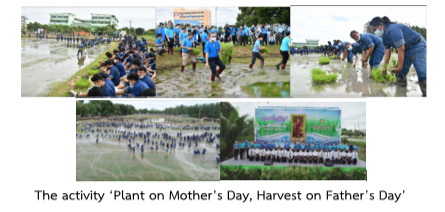
The rice planting activity “Planting on Mother’s Day, Harvesting on Father’s Day” was held on 12 August 2020 on the auspicious occasion of the 88th birthday anniversary of Her Majesty Queen Somdet Phra Nang Chao Sirikit Phra Borommarachininat Phra Borommaracha Chonnani Phanpi Luang. The villagers nearby collaboratively joined this activity at Thung Bang Plama. Kasetsart University, Suphanburi Campus.


Previous
Next
Kasetsart University Kamphaeng Saen Campus organized a tribute and blessing ceremony on the auspicious occasion of the 88th birthday anniversary of Her Majesty Queen Somdet Phra Nang Chao Sirikit Phra Borommarachininat Phra Borommaracha Chonnani Phanpi Luang. Tree planting and Kamphaeng Saen Campus developing activities were held at Thung Na Prai in Kasetsart University Kamphaeng Saen Campus, Kamphaeng Saen District, Nakhon Pathom Province. All participants, who are students and staff from various faculties, collaboratively joined the rice planting activity on Mother’s Day by throwing young rice seedlings into and manually transplanting rice seedlings in the prepared field of 13.5 rai (0.0216 square kilometer). Additionally, the participants planted trees and developed the area at the back of Kamphaeng Saen campus’s residential condominiums.
The demonstration rice plots under the “Pheum Kao (Increasing rice productivity)” project. It is the fact that, in the past, Thai farmers did not properly use fertilizers and no analysis of soil nutrient deficiency was conducted. They did not know what formula and the amount of fertilizers to be applied. These factors generated a higher cost of production with less productivity and soil deterioration. In this regard, Thai Central Chemical Public Company Limited and Kasetsart university Chalermphrakiat Sakon Nakhon Campus, Sakon Nakhon Province, therefore, jointly developed demonstration rice plots under the “Phuem Khao” project to increase Thai rice productivity and reduce production costs. The plot is in a farmer’s rice field, Khun Somjai Khruttamkham, located in the village no. 4, Chiang Krua Subdistrict, Mueang District, Sakon Nakhon Province. The project emphasizes the integration of advanced knowledge from the university’s research with the local wisdom and experience of farmers as well as the fertilizer production technology from Thai Central Chemical Public Company Limited. All knowledge is linked in every process of rice production starting from rice variety selection, water management, selection of agricultural factors, plot preparation, uses of agricultural information and technology such as proper the use of fertilizers, plant nutrition management of the specific area, fertilizer requirement for particular plants, increasing organic matter during break crops in the dry season to improve soil conditions. The project sets to be a learning center for agricultural development and to elevate some potential areas to be as a demonstration site for community agricultural development.
Socials engagement. Thailand is a country where rice is primarily consumed and it focuses on agriculture. Kasetsart University, therefore, organized the activity called “Planting rice on Mother’s Day and Harvest on Father’s Day” in order to transfer knowledge to students and villagers in the communities nearby the university.

3.3.7 Cement pond organic fertilizers Unused cement rings are used to make composting tank where leaves, twigs, and all organic solid waste are composted in the tank. Leachate and nutrients are extracted from the compost and it can be used as a fertilizer and the landscape site is still beautiful.
Agricultural innovation. The Organic Solid waste Disposal Project is the use of cement pond for disposing of household organic solid waste. Leachate with plant nutrients obtained from the compost can be used as a fertilizer and it makes the landscape beautiful.
3.3.8 Removal of water hyacinth
Public Service. Kasetsart University has transferred knowledge and solutions using a spraying machine to spray fungal biocontrol agent on water hyacinth leaves along the canals and swamps, both inside and around the university as well as in the communities located nearby.
Agricultural Innovation. Control of water hyacinth has been discovered using the concept of bio-control-controlling the organism by another organism. In this case, a specific fungus is used to cause many disorders and diseases of water hyacinths. Consequently, the water hyacinth is unable to grow and reproduce. In practice, the sprayer is filled with the fungi and spray it on the water hyacinth in particular areas.
Socials engagement. The research on the removal of water hyacinth is beneficial to many communities. Currently, Kasetsart University is also working with many organizations and the communities around Kasetsart University to remove water hyacinths. The result of this implementation is satisfactory and the operation extends to many areas such as Don Tum Subdistrict, Bang Len District, Nakhon Pathom Province; Bang Krasan Subdistrict, Chiang Rak Noi
Subdistrict, Pathum Thani Province; Bang Pa-in District, Phra Nakhon Si Ayutthaya Province; Si Kan Subdistrict and Don Mueang District, Bangkok Metropolis. This will reduce operation cost because it uses less manpower and no water hyacinth collecting machine is required.

3.3.9 Teak-leaf interior wall panels
The interior wall panels are 100% natural made from teak leaves which are produced from over nine-hundred thousand rai (1,440 square kilometers) of forest plantations. Each year there are enormous amounts of teak leaves fallen during defoliation. The teak leaves are easy to find because the teak plantations are distributed in many areas in Thailand, mostly found in the northern region. The teak leaves have been developed to be used as interior wall panels due to their properties of heat insulation and sound absorption.
The natural rubber obtained from the bark of Yang Bong tree (Persea kurzii Kosterm) is used as bonding glue which is safe to use, environmentally-friendly and free of chemicals and formaldehyde. It is local wisdom derived from their ancestors reflecting that this natural rubble has the potential to be applied as a bonding material to prevent the infestation of various insects. Currently, interior wall panels made from teak leaves are used for covering and decorating the wall in a building rather than using woods. It is safe for the environment and human. It effectively reduces the heat and noise penetrating from outside into the inside of a building. The teak-leaf wall panels are suitable for various buildings and houses. The panels can be directly attached to an original wall or attached on a rough frame to be used as a room divider. This is the addition of value for natural waste materials.
Public service. A lot of teak leaves defoliated from the tree are considered as natural waste and are not utilized. Normally, the leaves are usually disposed of by burning, which pollutes the environment. Researchers, therefore, realized the importance of adding value to the teak leaves by making teak-leaf interior wall panels since the leaves contain fibers that have are heat-insulating and soundproofing. This research is one of the alternatives and it is useful in reducing the natural waste caused by a large number of teak leaves.
Agricultural innovation. The research of teak interior wall panels won the Innovation Award at the WiC2015 Exhibition in Seoul, South Korea. This research uses teak leaves for developing interior wall materials. Teak leaves are produced from over nine-hundred thousand rai (1,440 square kilometers) of forest plantations. Each year there are enormous amounts of teak leaves fallen during defoliation. The teak leaves are easy to find and the leaves have the properties of heat insulation, noise absorption and having effective repellants against leaf-eating insects, particularly termites. The bonding glue, obtained from the bark of Yang Bong tree (Persea kurzii Kosterm) is used to attach the panels. The glue is a natural material which is safe to use, environmentally-friendly and free of chemicals. This is the addition of value for natural waste materials.
Socials engagement. This research has collaborated with many departments, namely Dr. Sopa Visitsak, a lecturer at Department of Building Innovation, Faculty of Architecture and Assoc. Prof. Dr. Songklod Jarusombat, the Department of Forestry, Faculty of Forestry, together with Ms. Passorn Klinrod and Prof. Dr. Joseph Khedari, Department of Building Innovation. Faculty of Architecture Kasetsart University.
3.3.10 EMARBLE: Artificial Stone from Egg Shell
Thailand has its capacity to produce more than 15,000 million chicken eggs per year to support consumption in form of both fresh eggs and the eggs used by various processing industries. Nowadays, although this eggshell waste is often used as an ingredient in the production of fertilizer and animal feed, it is a very small proportion compared to the total amount of eggshell waste generated daily. Assoc. Prof. Singha Intarachuto, Head of the Environmental Design Center, Department of Building Innovation, Faculty of Architecture, Kasetsart University, and his research team has researched on the use of everyday garbage such as eggshell waste with the integration of science and art to create a useful product called ‘EMARBLE’ which is an innovative material made from eggshell waste.

The work is resulted from the collaboration of designers and scientists (Art and Science) with its design concept of practicality. It can be molded to be construction materials for making various furniture for buildings, houses, offices, restaurants, schools, hospitals etc. The artificial stone “EMARBLE” is an international innovation and it has never been created from eggshells for industrial construction. This is because the leftover eggshell waste becomes quickly stinky and a thin membrane in the eggshell makes it difficult to adjust scale which affects the development of composite materials. The manufacturing process of this material requires a lot of eggshells so it helps reduce waste and increase the value of waste materials.
Public service. Research The research on ‘EMARBLE’: artificial stone from eggshells is led by Assoc. Prof. Singha Intarachuto, Head of the Center for Environmental Design Creation, Department of Building Innovation, Faculty of Architecture, Kasetsart University and conducted by the EMARBLE research team. The manufacturing process requires a lot of eggshells, which its quantity of this waste is currently huge. Utilization of eggshell waste by modifying them into various inventions can help reduce such amount of waste and it can also increase the value of waste materials as well.
Agricultural innovation. This research was awarded the first prize by the Kasetsart University’s Innovation Competition. The research uses everyday waste such as eggshell waste to create “EMARBLE” which can be molded into construction materials such as building materials, wall paneling materials, tiles, mosaic and synthetic stones of various shapes. Such materials can be used for interior, building, houses, offices, restaurants, schools, hospitals, etc. The artificial stone “EMARBLE” is an international innovation and it has never been created from eggshells for industrial construction. This is because the leftover eggshell waste becomes quickly stinky and a thin membrane in the eggshell makes it difficult to adjust scale which affects the development of composite materials.
Research on the development of fire-retardant materials from para-rubber wood chips.
Agricultural innovation. This research was conducted by Assoc. Prof. Songklod Jarusombat from the Department of Forestry, Faculty of Forestry, Kasetsart University, and his research team developing a fire-resistant wood from various materials such as rubber woods, small woods, wood chips from a rubber-wood processing plant, and other wood waste from other processing. Cross-lamination or laying three layers of the materials on different directions is used to enhance its strength. It can withstand 3-5 times of loadings compared to the wood with ordinary structure. When it is compressed with the boron compound solution, it becomes fire-retardant and it can protect itself from termites and weevils making the wood last longer. It is considered as a worthwhile use of woods and it helps protect the environment. The fire-retardant material has the same properties as wood. It can be nailed and formed into different parts such as doors, windows, wood panels, etc. The knowledge from this research can be disseminated to the private sector for further commercialization.
Covid-19
Prior to the Covid-19 situation, Kasetsart University has managed organic solid waste for many years to achieve a Zoro Waste.
During the Covid-19 situation, Kasetsart University has protective measures to deal with the Covid-19 including maintaining social distancing, online teaching, closure of cafeteria hall and encouraging people to wear a mask to prevent the spread of Covid-19.
Challenge. Kasetsart University has encouraged students and community members to know about organic solid waste treatment. Organic solid waste can be utilized in many research projects which can further develop many ideas regarding organic solid waste treatment. This reduces a large amount of solid waste and some useful products can be created from organic solid waste. The research projects help solve the problems in the communities located near Kasetsart University, for example, the project on organic solid waste disposal tank, which is built from concrete, is the treatment of organic solid waste at a household level. If this facility is available in every household, the amount of organic solid waste in the community will be reduced. Besides, organic solid waste treatment tank can be a source of nutrients for the edible plants grown for household consumption.
Opportunity. Kasetsart University foresees opportunities to develop the projects regarding organic solid waste by participating in the activities with local communities such as the use of black soldier fly larvae for composting, production of biogas and liquid fertilizer, making compost for gardening purpose, disposing of rotten fish, making compost from weeds, pig feces, cow feces, palm leaves, dry- and wet- composting tank, fertilizer from the rice experimental plot and organic solid waste disposal facility. All are the projects that Kasetsart University has conducted in collaboration with the communities in order to promote the communities’ knowledge, income and cost-saving.