
EDUCATION


6.3-1
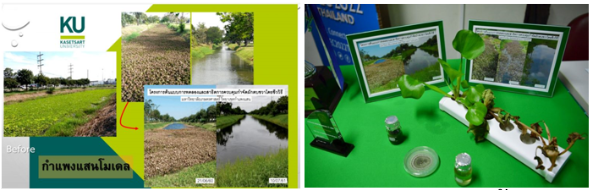
Publication of “Elimination of Water Hyacinth by Using Fungi”
Kasetsart University held a Memorandum of Cooperation Signing Ceremony in bringing research and development of science, technology and innovation to manage and solve water hyacinth problems and create careers for people between Kasetsart University with provincial administrative organizations in 7 provinces, namely Chiang Rai, Nakhon Phanom, Maha Sarakham, Sakon Nakhon, Nong Khai, Nong Bua Lamphu and Amnat Charoen. The objective is to integrate cooperation between Kasetsart University and the provincial administrative organizations of 7 provinces, namely Chiang Rai, Nakhon Phanom, Maha Sarakham, Sakon Nakhon, Nong Khai, Nong Bua Lamphu and Amnat Charoen according to the national strategy and policies of the Ministry. of Higher Education, Science, Research and Innovation in bringing scientific research and development results of Technology and innovation to manage and solve problems of water hyacinth and weeds in water sources to be a quality and environmentally friendly water source. including the promotion and development of labor skills and using local raw materials, developing products to generate income and create jobs for people in the province.
The work has won awards from research, innovations and innovation contests on national and international forums, including:
- Bronze Award from the Contest of Research, Invention and Innovation at THE 15th INTERNATIONAL WARSAW INVENTION SHOW” (IWIS 2021) in Warsaw, Poland. Between 25-27 October 2021
- Silver Medal Award from the Contest of Research, Invention and Innovation at the 2021 Kaohsiung International Invention and Design EXPO (KIDE) in Kaohsiung, Taiwan, during December 2-4, 2021.
- Gold Award from the Contest of Research, Invention and Innovation at the Seoul International Invention Fair (SIIF 2021) in Seoul, Republic of Korea between 4-5 December 2021
- Gold medal and WIIPA Special Award from research, invention and innovation contest at the 2022 Shanghai International Invention&Innovation Expo in Shanghai People’s Republic of China during 14-16 April 2022
Because water hyacinth is a rapidly propagating aquatic weed and is a problem in natural water sources, it is a problem for communities, agriculture, and transportation. However, there is no technology or approach that can sustainably eliminate water hyacinths and reduce water hyacinth disposal budgets. Therefore, fungal biologic agents have been developed and have the potential to control water hyacinth infestations, which has passed security checks in various fields. The study of the mechanism of pathogenicity by enzymes or substances produced by fungi and affecting dried water hyacinths.
The success of the research that has been studied for more than 12 years can extend the utilization and transfer of technology in the form of academic services to various communities, including government officials, provincial administrative organizations and government agencies that are directly involved. with the removal of water hyacinths in water sources such as major rivers, irrigation canals and reservoirs in various areas to solve the problem of water hyacinth, which can be combined with the original method, which will reduce the budget for water hyacinth disposal in various water sources.
6.3-2

Publication of “Leave Vessel Forming Apparatus”
Prof. Nongluck Lekrungruangkit, Energy and Environmental Engineering Laboratory, Faculty of Engineering, Kasetsart University developed a banana leaf/leaf compactor. It is characterized by a 2-head press to support the production of large-scale leave vessels by using local materials that are easy to find, such as banana leaves, lotus leaves, teak leaves, bamboo shoots, banana sheaths, water hyacinths, and bodhi leaves, which are natural materials, no toxic substances that affect the health of consumers. The apparatus can support to form vessels of different shapes. The equipment can be used with 220 V household electricity, consumes 700-2,000 watts of power and can adjust the working temperature from 0-300 °C. There is a sound notification system when the working time is over. It can be stored for more than 30 days in sealed bags and the production of spoon presses has been expanded.
6.3-3

Publication ” The process of producing edible film from mango and products obtained from such process ”
Prof. Dr. Rangsinee Sothonwit, Department of Food Engineering, Faculty of Engineering, Kasetsart University, was granted a patent for “the process of producing edible film from mango and products obtained from such process”, patent number 84494, and was granted the protection. by the Department of Intellectual Property on October 1, 2021.
The edible film production process from mangoes which consisted mainly of mango juice with lipids and fatty acids, consisted of preparation of mango juice, preparation of film-forming mixtures of mango juice with fatty substances and fatty acids, forming the mixture into mango film and adding. antimicrobial properties to the film with the special characteristics of the process. Production with the addition of antimicrobial extracts from the pulp or rind of mango results in a yellowish film with good physical and mechanical properties and antimicrobial ability. It can be applied as packaging or as part of the packaging to preserve the quality of food and fruits and vegetables. This work is published and citations 2% of the world ranked 779 out of 48,453 people in Food Science.
6.3-4

Publication of “Light Path Control Devices”
Associate Professor Dr. Ronnarit Rittiron, Department of Food Engineering Faculty of Engineering Kasetsart University and Asst. Prof. Dr. Dusit Thanaphethai, Department of Electrical Engineering Faculty of Engineering, Kasetsart University received a petty patent of “Light Path Control Device”, Petty Patent No. 18395, protected by the Department of Intellectual Property on October 18, 2021.
The optical path controller based on this invention aims to develop a structure that can effectively direct the path of light into fiber optics. The halogen lamp is the light source for the spectrophotometer that is commonly used. The nature of the design, shape and materials used in conjunction with halogen lamps will vary according to usage. Based on this patent, two unique parts are designed to direct the direction of light emanating from a halogen lamp so that it can travel into fiber optics more efficiently. The first invention is cylindrical, with a hollow interior so that the halogen lamp can be inserted inside and held the halogen lamp in place. The second invention is also cylindrical. There are two types of hollow interiors, cylindrical and conical, so that the desired light intensity can be selected. The two inventions are connected by threads so that light can be directed from large halogen lamps into fiber optics with smaller channels, which can illuminate points on the sample effectively.
6.3-5

Publication of “Wire binding device”
Associate Professor Dr. Nantawat Khomwan, Department of Civil Engineering, Faculty of Engineering Kasetsart University received a petty patent”Wire binding device”, Patent No. 18395, protected by the Department of Intellectual Property on February 17, 2022.
This invention can tie the wire by turning the threaded hook by pulling the device towards the user. The wire binding device consists of a hook rod attached to a rod-shaped hook with a threaded groove mounted in a handle sleeve. Inside the casing, there is a rotation controller in a form of tenon or bearing To control the rotation of the hook axis to move along the thread of the hook axis. There is a rotation hook to prevent the hook from turning while attaching the wire to the steel rod and to help keep tighten the wire before beginning the wire binding process. There is a spring connected between the hook axle and the cover of the sleeve. When the tensile force is applied to the sleeve, the power is transferred to the hook core, causing the hook core and the hook rod to be connected to the wire to rotate. The wires are then wrapped together and the steel rod is fixed. And when binding the wire successfully, the hook can automatically turn back by the tension of the spring.
6.3-6

Publication of “Cannon Shooting Game”
Associate Professor Dr. Siwaluk Pataveerat, Department of Agricultural Engineering, Faculty of Engineering, Kasetsart University et al received a petty patent of “Cannon Shooting Game Machine” Patent Number 87402, protected by the Department of Intellectual Property on April 8, 2022.
Cannon shooting game machine is characterized by a tennis ball launcher, consisting of a frame. The lower part of the frame is attached to the towing arm and the shaft connected to the tractor wheels on both sides. The center of the frame features an oblique extension tube and a mounting bar between the lower part of the frame and the barrel adjacent to the top of the frame. The barrel stand has a hole for adjusting the angle of fire of the barrel and has a rod stand and a controlling mechanism assembled next to each other. The barrel and chamber, which are bolted together, are mounted on the barrel support. The upper part of the barrel consists of a pressure chamber attached to the air source opening valve, followed by the air source (external air pump), and a pressure gauge is mounted on top of the gun barrel pressure chamber. The center of the barrel is equipped with an air release valve located in the valve chamber. The center of the barrel is equipped with an air release valve located in the valve chamber. The bottom of the valve chamber is connected to the rod and the controlling mechanism at the end of the rod, and the controlling mechanism on the other side rests on the rod cradle. The control mechanism within the upper barrel consists of bullet lock chamber that holds pressure and releases bullets well. Compression shots will use the rod to send bullets to compress the projectiles into the locking chamber by firing bullets will rely on the rod and mechanism to open and close the air vent. When the rod and actuator open the vents, air pressure from the chamber pressure chamber at the valve chamber pushes the projectile out of the chamber and through the barrel until it escapes the barrel as well as being the source of sound and smoke from the barrel. This invention can be used as a device to shoot projectiles (tennis balls) at targets in games, competitions, events, as well as to make players have knowledge of physics and have fun.
6.3-7
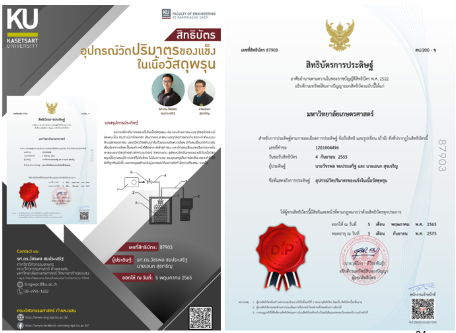
Publication of ” A device for measuring the volume of solids in porous materials ”
Associate Professor Dr. Watcharapol Chayaprasert, Department of Agricultural Engineering, Faculty of Engineering, Kasetsart University and Mr. Anek Sukcharoen, Former Engine Mechanic, Research and Academic Services Administration Division, Kasetsart University received a petty patent of “A device for measuring the volume of solids in porous materials”, Patent No. 87903, protected by the Department of Intellectual Property on May 5, 2022.
A device for measuring the volume of solids in porous materials consists of a sample container with a tight cover. The volume of the sample material container must have the exact value. The outside of the sample container is insulated with an air hose connected to a flow regulating valve. An air compressor will pump air into the container, and an air hose connects the volume inside the sample container to the pressure measuring device. This porous solids volumetric device features simple measurement, no effect of temperature on the volumetric measurement, providing more accurate values, easy for maintenance, accurate and fast measurement results.
6.3-8
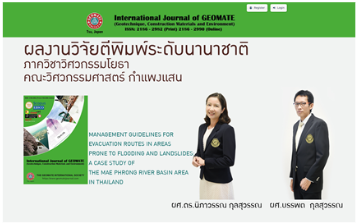
Publication of “Guidelines for the management of evacuation routes in flood and landslide prone areas: a case study of the Mae Phong River Basin, Thailand.”
The work by Asst. Prof. Dr. Nipawan Kulsuwan and Asst. Prof. Banpot Kulsuwan, Department of Civil Engineering Faculty of Engineering, Kasetsart University has been published internationally in the International Journal of GEOMATE (Geotechnique, Construction Materials and Environment) ISSN: 2186-2982 (Print) 2168-2990 (Online), an International. Journal of Japan on “Guidelines for the management of evacuation routes in flood and landslide prone areas: a case study of the Mae Phong River Basin, Thailand”. The objective of this study was to find a suitable evacuation route to prepare for such incidents to benefit local authorities, including people living in steep areas in Uttaradit Province. Evacuation routes were analyzed with a travel distribution model using a theoretical analysis technique to determine the shortest distance from the model results for the evacuation model and the time it took for the evacuation in each case. It will be helpful to consider planning the evacuation warning period in advance. In addition, in steep or similar areas of study, local authorities can also use this analysis method as a guide for planning evacuation in the event of floods and landslides.
6.3-9

Publication of “The study of the performance and analysis of the energy mass balance of the gas-circulating charcoal furnace from the biomass in the furnace.”
The work of Asst. Prof. Dr. Kanit Manathu, Department of Mechanical Engineering Faculty of Engineering, Kasetsart University has been published internationally in Energy for Sustainable Development Volume 64, October 2021, Pages 8-14. The research article is in the Scopus Q1 database. This research examines the performance and analyzes the energy mass balance of the gas-circulating charcoal furnace from the biomass in the furnace. The heat given to the furnace is from burning wood chips in front of the furnace with the volatile biomass in the furnace. The biomass used to produce charcoal are bamboo and coconut shells. The results of the test showed that the maximum temperature of the furnace was 400 degrees Celsius, the mass yield and energy were between 38-45% and 56-86%, respectively. Carbon content of charcoal was 62-64%, furnace efficiency was 56-85%, which was 50% higher than conventional furnaces with furnace efficiency. The heat from the circulating gas not only increased the efficiency of the furnace, but also increased the productivity.
6.3-10
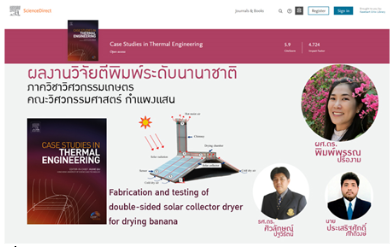
Publication of “Double Sided Solar Panel Dryer”
The work of Asst. Prof. Dr. Pimphan Priangam and Assoc. Prof. Dr. Siwaluk Pataveerat, Department of Agricultural Engineering Faculty of Engineering Kasetsart University and Mr. Prasertsak Phakdiwong, a researcher, published internationally in Case Studies in Thermal Engineering Volume 27, October 2021, 101335, in which the research article is in the Scopus. Q1 database. ”Double Sided Solar Panel Dryer” was designed so that the solar panels were installed on both sides of the drying chamber at an angle of 15° to the floor with a total radiation area of 7 m2. The test was done by drying bananas for an initial moisture content of 68.5 %(Wb) for 5 days. It was found that the final moisture content of bananas in the dryer and bananas naturally dried in the sun were 17.4%(Wb) and 27.3%(Wb). respectively. The maximum internal temperature of the dryer was 62.7 °C and the average was 54.1 °C, which was higher than natural sunlight at 13.6 °C. The high drying rate of this double sided solar dryer would reduce moisture content 1.3-1.5 times faster than in natural sunlight. The average thermal efficiency of dryer and solar collector efficiency was 13% and 21.9%, respectively.
The advantages of this double-sided solar dryer are that it can produce more hot air and lower relative humidity than traditional solar dryers, and an increase in the number of material shelves in the drying room, in addition to increasing the drying capacity, it was found that the bananas in the drying chamber placed on all 3 stainless steel sieve racks had similar decreases in moisture content.
6.3-11

Publication of “Using ohmic pasteurization method to prevent pinking in coconut water during storage.”
The work of Asst. Prof. Dr. Kobsak Kanchanapongkul, Department of Food Engineering and Ms. Weeraya Baibua, Graduate Student, Faculty of Engineering, Kasetsart University has been published internationally in the Journal of Food Engineering Volume 292, March 2021, 110268, where the research article is in the Scopus Q1 database. In this study, the ohmic pasteurization method was applied to prevent pinking in coconut water during storage, as measured by the inhibition of polyphenol oxidase activity (PPO) and the enzyme peroxidase (POD) in coconut water, which causes pink. The results showed that heating the coconut water at 90oC completely inhibited POD activity, but the PPO activity remained about 10%, indicating that the PPO behaved according to the two-phase model. From testing the coconut water properties during refrigeration storage, it was found that the PPO activity in the coconut water samples gradually increased over time. The boiling-heated coconut water sample turned pink on day 14 of storage. While the sample was ohmic heating, no pink color was observed. The results showed that the ohmic heating method was effective in preventing pinking in coconut water.
6.3-12

Publication of “Water aerator, solar cell water turbine”
Assoc. Prof. Dr. Somchai Donchedi is the creator of the innovative 350w dc solar cell aerator water turbine (8 blades, 4 rings) for the use of aerators. The water turbine uses clean energy directly from the sun. It is suitable for shrimp farms, fish farms, aquaculture farms and various ditches to help increase aeration, increase water oxygen, treat waste water and reduce water wastewater generation.
Details
- 100% solar powered, no batteries.
- 2 buoyancy buoys and stainless steel construction for long service life.
- Turbine size 28 inches, 8 blades, 4 rings
- Use a direct reduction gear motor for solar cells 350w 24V (DC Brushless) without battery conversion, providing high efficiency.
- 1 POLY 330w solar panel
- 350w Brushless motor control box with variable speed control device (Round speed depends on sunlight).
Unique feature
- Start working when the solar panel is exposed to a certain level of sunlight.
- Increase the oxygen in the water and cause water circulation.
- Use 100% natural energy
6.3-13

Publication of “Bottom spray fluidized bed coating machine: Influence of variables affecting grain coating efficiency”
Asst. Prof. Dr. Preeda Prakotmak. This research aimed to construct a small-sized fluidized bed coated rice machine with bottom coating spraying, and to study the influence of various variables on coating efficiency. The experiment was done by coating a solution of turmeric extract on the surface of jasmine rice 105. The coating was sprayed from the nozzle at the rate of 30, 35 and 40 ml/min. The air being fed to the nozzle with pressures of 1 and 1.5 bar was sprayed for 8 and 10 min. And after stopping spraying the coating, continue drying for another 30 and 10 seconds while the air flow into the drying chamber with a speed of 2.5 m/s and a temperature of 55, 60 and 65ºC, 80% of the recirculated hot air volume. The quality of coated rice was determined by the moisture content, color value, percentage of grain cracking and evaluating the coating efficiency. From the experiment, it was found that the optimum conditions for the production of turmeric coated rice extract were: drying air at 55ºC, spraying rate of 40 ml/min, pressure of air feeding to nozzle at 1.5 bar, spraying of coating at 8 minutes. After stopping spraying coating, drying was continued for another 10 seconds. The resulting turmeric extract coated rice was reddish-yellow in color. Increasing the drying temperature, drying time after coating spraying and coating spraying time resulted in lower moisture content of coated rice. Increasing the drying temperature and coating spray rate had no effect on the grain cracking percentage and the coating efficiency of the machine ranged from 78.2-82.9%.
6.3-14
Development of Cooling and Modified Atmosphere Storage Equipment/Systems for Fresh Produce Transport and Distribution
Authors: Napat Suebsiri , Weerachet Jittanit Kasetsart University. Agro-Industry
This research conducted the storage experiments of cantaloupe melon, cos and green oak salad produces under three major different conditions comprising (1)the optimum storage condition referred from the reference (temperature of 5 °C), (2) the storage condition that has lower expenses and suitable for the farmer using temperature in the range of 12-18 °C, and (3) the storage at room temperature. Along the storage period, the salad produce samples were examined for their characteristics including appearance, weight loss, respiration rate, firmness, color, aerobic plate count and total yeast and mould count in order to compare and determine the suitable storage condition for the design and fabrication of the storage equipment/systems fruits and salad produce transportation and distribution that are affordable. After that, the invented equipments were tested with the intension to develop the appropriate technology for Thai farmer for escalating their competitiveness in the high-standard market. The results indicated that the qualities of cantaloupe melon and salad produces directly related to their storage temperatures. This study demonstrated that 5 °C is the best storage temperature among its counterparts for post-harvesting of cantaloupe melon. Though the storage temperature at 5 °C could maintain the quality of product for roughly 3 weeks, the storage temperature at 12, 15-18 °C and the invented storage equipment at 13 °C might be preferred if the needed shelf lives are approximately 10-12 days due to its cheaper investment and operating cost for refrigeration facilities. The storage at 5 °C leaded to the shelf life of not over 8 days for Cos and around 4 days for green oak prior to the noticeable alternation of their appearance. It is because at this temperature the products have the lowest respiration rate and quality change compared to its counterparts. In contrast, the storage at room temperature resulted in the shortest shelf life; therefore, it should not be applied to the salad produce. The application of the invented storage equipment at 13 °C and the chilling cabinet at 15-18 °C resulted in the slightly different respiration and quality alteration rates according to their different temperature levels. The storage lifes of both Cos and green oak were around 4 days in the invented storage equipment at 13 °C. Besides, the application of pre cooling technique using the invented equipment of the project I together with the invented storage equipment of this project could retard the changes of product qualities in the starting storage period compared to those without the application of pre cooling technique. It appeared that the storage equipment and the transportation bag invented in this project had the efficiency as required. They can be utilized and extended their benefits by Thai farmer. These technologies help the farmer to have more flexibility in their logistics management because the farmer does not have to deliver their fresh produces to the market within the short time. Also, the invented storage equipment has lower equipment cost and energy expense than the cold storage that generates the temperature of 5 °C. The transportation bag that was invented in this project could be utilized by the farmer in the online trade. The farmer can directly sell and deliver their products from farm to the consumer while maintaining the premium product quality; as a result, the income of Thai farmer can be sustainably escalated.
6.3-15
Life Cycle Assessment of Municipal Solid Waste Valorization Options in Thailand
Authors: Phoowadon Prapruetdee ,Nutchapon Chiarasumran Kasetsart University. Sustainable Energy and Resources Engineering.
A gate-to-gate Life Cycle Assessment of Municipal solid waste (MSW) was studied to compare the environmental impacts among three different waste valorization options, both exist in Thailand and an interesting waste-to-energy (WtE) technology options: incineration, mechanical-biological treatment (MBT) for biogas and refuse-derived fuel (RDF) production, and gasification combined with methanol production. The three scenarios with a 50ton/d basis of MSW was used to calculate mass balance and energy consumption, having a composition evaluated from Nong Khaem solid waste disposal center, Bangkok, Thailand. The incineration and gasification combined with methanol production were simulated using UniSim Design to complete their models. MBT for biogas and RDF production process was completed by adapting the previous model for a study of MBT for MSW valorization in Saraburi, Thailand. Additional data from a few websites were used to complete electricity consumption in all scenarios. The potential of life cycle environmental impacts from three valorization options were evaluated, implementing 1 ton of MSW as a functional unit using ReCipe2016 in SimaPro. The results demonstrates that gasification combined with methanol production has the potential to create most environmental impacts in all categories while incineration process has impacts on climate change and Urban land occupation. MBT for biogas and RDF production shows adverse impacts on most categories which tend to benefit from its process than damages. From most of avoid-burden-environmental impacts, thus, MBT for biogas and RDF production is considered the most applicable process among three MSW valorization options.
6.3-16
 Persistence of Tilapia tilapinevirus in fish rearing and environmental water and its ability to infect cell line
Authors: Jidapa Yamkasem,Tharinthon Prasartset,Puntanat Tattiyapong,Kwanrawee Sirikanchana
Tilapia tilapinevirus, or Tilapia Lake Virus (TiLV), is a RNA virus associated with mass morbidity and mortality in tilapia, leading to severe economic losses for global tilapia aquaculture. In this study, we investigated the persistence of TiLV in water by spiking sterile distilled water (SDW), freshwater collected from rearing fish tanks (FW) and natural pond water (PW) at 27°C as a representative of environmental water conditions with 0.6 ml of stock virus (3.18 × 10⁷ viral copies/ml of water). The water samples were filtered through an electronegative charge membrane and quantified using reverse transcriptase quantitative PCR at 0, 3, 5, 7, 10 and 14 days post-inoculation. The results revealed that TiLV RNA in SDW was reduced by 1.34 log10 in 14 days. A similar approximately 4 log10 removal of the virus in FW and PW was observed at 3 and 7 days, respectively. Moreover, the infectivity of TiLV was further studied; the virus lost its infectivity in E-11 cells after 1 day in SDW, FW and PW water samples, even though the virus was spiked 10 more times than in the viral persistence study. Taken together, the results could be applied to improving biosecurity practices in tilapia farms by disinfecting or resting reservoir water for at least three to five days prior to stocking tilapia, to limit the spread of TiLV.
6.3-17
Social Network Analysis of Free-roaming Dogs in Kasetsart University, Kamphaeng Saen Campus
Authors: Tipsarp Kittisiam, Waraphon Phimpraphai Kasetsart University. Veterinary Medicine
Free-roaming dogs are commonly found in many developing countries. They represent a One health issue involving the health of humans, animals, and environmental health. One of the most important concerns is that they are the most important reservoir for rabies, the lethal zoonotic disease. Thailand has an abundance of free-roaming dogs found in every province. Current rabies and dog population control strategies can be drastically improved from novel insights. Social network analysis is a tool that can be used to study interactions between certain individuals. It is a technique that has been widely applied in preventive veterinary medicine and has proven to provide novel insights in understanding the spread of diseases. However, knowledge on the social network analysis of domestic dogs is limited. The objective of this study was to describe and explore the social network of free-roaming dogs that inhabit Kasetsart University, Kamphaeng Saen Campus, using observational methods. The results of this study included multiple dog-to-dog networks of co-occurrences. Network parameters were calculated, and permutation-based statistical tests were performed to assess the difference of the parameters between groups of interest. In this study, the average number of edges per dog was 6.74. The dog-to-dog networks were identified as small-world networks. The normalized degree calculated from the network of dogs observed on the weekend was higher than the dogs observed during the weekdays. The largest component was identified for each dog-to-dog network. The majority of dogs in this study were repeatedly observed in one area. The average number of dogs associated with one area was 8.67. The network information gathered proved to be sufficient to create networks that can represent potential contacts, demonstrating the potential of observational data collection in resource-limited situations. Furthermore, networks created in this study can be used in disease modeling to design more targeted rabies and dog population programs in the future.
6.3-18
Study of Muntingia calabura as an Alternative Fruit for Consumption
Authors: FITRIANA NASUTION, Jenjira Chumpookam Kasetsart University. Agriculture
Muntingia calabura may be an alternative food because this plant can grow and adapt in difficult environmental conditions without cultural practices, and the fruit is nutritious. Muntingia calabura can be processed for greater economic value, however the limitation of literature and information of Muntingia calabura are matters to improve the plant as a commercial fruit. Due to this issue, this study combined some aspects, i.e., morphological and molecular characteristics, propagation method, utilization of fruit as a raw material to produce some products and fruit maturity stage as a unit technology to increase economic value of Muntingia calabura. These components are important to improve Muntingia calabura as a commercial or alternative fruit in the future. Besides that, the utilization of Muntingia calabura as a raw material to produce some products is very useful to increase farmers` desire to cultivate this tree. This present study found data which can develop Muntingia calabura as a “commercial fruit” in the future. The consequences of this study are: based on morphological and molecular characteristics, the eight accessions of Muntingia calabura studied have low diversity. Thus, these accessions are not suitable to be selected as mother plants for cross breeding activity, air layering is a suitable method for propagation in Muntingia calabura, stage three (the ripe stage) is the most appropriate stage of fruit to be processed. The final product is stable and able to withstand for a long time. It is acceptable by consumers. This research can be a fundamental method in the future because there is limited literature on propagation of Muntingia calabura.