Setting And Inflastructure


1.14.1
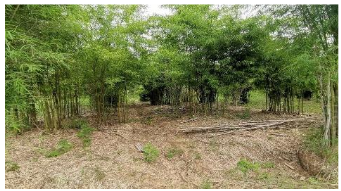 Bamboo plot
Kasetsart University, Sakon Nakhon Campus has prepared a bamboo plot to collect 57 bamboo species. Bamboo belongs to the Gramineae family, Bambusoideae subfamily, which is a field crop native to and widely distributed throughout the tropics, warm and cold. It is found mainly in the tropical regions of Asia. There are 47 genera distribution and 1,250 species. For Thailand, it was found that there are 15 genera of bamboo, approximately 82 species. Bamboo is important to the country’s economy. both food sources, industry and exports. Bamboo products are raw materials for the production of various products such as paper, artificial silk and bamboo plywood, etc. Exports each year can generate income for more than a hundred million baht and tend to increase all the time. Bamboo is beneficial both directly and indirectly. Almost every part of bamboo can be used for all purposes.
1.14.2
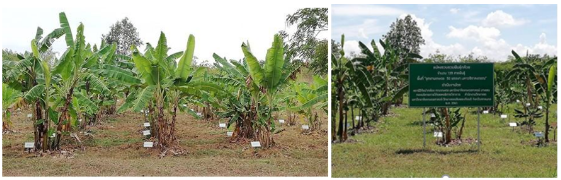 Banana collection plot
Kasetsart University, Sakon Nakhon Campus has a collection of 20 banana species in the area to be a learning center on banana cultivation for students, and the general public.
1.24.3
 Cassava cultivar collection plot
Kasetsart University, Chaloem Phrakiat Campus, Sakon Nakhon Province has developed cassava focusing mainly on farmers in the northeastern region. There are 3 main tasks in the cassava development process, which are
- Development of cassava cultivars to respond to the needs of farmers in each area in the Northeast with differences in both natural environment and production factors, as well as to test the performance of the cultivars in order to prepare the cassava before distributing to target farmers.
- Producing and propagating cassava to be a distribution center with quality species (accuracy according to species characteristics), cleanliness of species (Free from serious communicable diseases and disease vectors) and sufficient to meet the needs of target farmers to use.
- Transfer the whole system of knowledge to the target groups of farmers through training methods, various platforms, and field visit the farmer’s test plots.
Cassava cultivars under testing with good prospects and those that have been successfully tested and registered are classified into three groups for propagation and distribution:
- Certified cultivars consist of ku50, ku72 and ku80 ready for distribution to farmers.
- Cassava that has not yet been bred includes ku Sakon, ku Udon, ku Korat and ku Lopburi, all of which are also produced for distribution.
- Goos cassava from test plots and alternative starch cassava cultivars consisted of ku1, ku2 (fresh cassava) and hybrids from 2016–62.
Banana collection plot
Kasetsart University, Sakon Nakhon Campus has a collection of 20 banana species in the area to be a learning center on banana cultivation for students, and the general public.
1.14.4
 Center of Excellence for Rice Innovation.
It is a center established to gather personnel and research groups with expertise in rice of Kasetsart University to have the opportunity to exchange knowledge and research on rice, working together to formulate strategies and directions for specific research in the field of rice of the University to be correct, comprehensive and get the most benefit. It also provides academic services on rice to the government and private sectors, including organizing seminars and technology transfers to industrial groups both domestically and internationally. The university has three main groups of human resources with expertise and academic strength in the field of rice:
The rice varieties and production group specializes in breeding, rice production technology and postharvest technology.
Rice Product Quality Control and Development Group specializes in rice product quality control, rice product processing technology and rice product development.
Rice Economics Group specializes in production costs, marketing rice and rice products, as well as social development and local wisdom.
1.14.5
 Center of Academic Excellence in Agricultural and Food Machinery.
Kasetsart University established the Center of Academic Excellence in Agricultural and Food Machinery to be an international specialized center for agricultural and food machinery in teaching, research and commercial academic services from raw material production, agricultural machinery development, food product processing and quality control and agricultural value-added products production.
1.14.6
 Center of Academic Excellence in Silk.
Kasetsart University established the Center of Academic Excellence in Silk to enhance the knowledge and management of silk from upstream, midstream to downstream in order to create stable careers for Thai farmers and increase business potential for the silk industry.ฃ and related industries, providing silk knowledge services to society and leading the way in solving various silk problems, including conserving and conserving the country’s silk arts and culture to be sustainable forever.
1.14.7
 Center of Academic Excellence in Rubber.
Kasetsart University established the Center of Academic Excellence in Para rubber to be an international center specializing in rubber in terms of learning, teaching, research and academic services ranging from raw material production, natural rubber development, value-added product processing of latex and rubber wood.
1.14.8
 Center of Academic Excellence in Palm Oil.
Kasetsart University established the Center of Academic Excellence in Oil Palm to be an international center specializing in palm oil in terms of learning, teaching, research and academic services from raw material production, product processing and added-value product production for the development of the palm oil industry and continuous industries as well as the biodiesel, Bioethanol and oleochemical industries.
1.14.9
 Center of Academic Excellence in Jatropha.
It is a center of academic excellence on jatropha ฃ that can build connections in various fields with jatropha agencies around the world, strengthen Kasetsart University as a center for jatropha database and produce academic personnel in the field of jatropha.
1.14.10
 Center of Academic Excellence in Sugarcane.
Kasetsart University established the Center of Academic Excellence in Sugarcane to be a center specializing in national and international sugarcane fields in terms of learning, teaching, research and academic services, technology transfer from sugar cane production, value-added product development of sugar cane.
1.14.11
 Center of Academic Excellence in Bamboo.
Kasetsart University established the Center for Academic Excellence in Bamboo to promote research and development on bamboo for commercial purposes in order to disseminate and publicize the Center of Academic Excellence in Bamboo as well as academic services on bamboo to agencies in both Public and private sectors and people who are interested in general to create networks and cooperation on bamboo with government and private sectors both within the country and abroad and to gather information and create an academic database on bamboo.
1.14.12
 Vaccine and Biological Innovation Center.
Vaccine and Biological Innovation Center “Vaccination of Kasetsart University for Agriculture of Thailand” brought results in the form of vaccines, biological products for animal disease control and prevention, an innovative platform for designing various types of vaccines and a prototype factory for production of vaccines and biological products that were ready to transfer technology to the private sector, farmers and interested parties to exhibit such as Vaccines for tilapia – oral and injectable type, Vaccines for seabass, Vaccines against Emerging Viruses in Tilapia and Red Tilapia, Environmentally Friendly Cattle Tick Vaccine , Vaccines for the control and prevention of PRRS disease in pigs.
1.14.13
 Duck Health Research and Development Network Center.
Kasetsart University established a research and development network center on duck health science as a research center aiming for academic excellence in duck health science, aiming to produce research and development of technology related to duck production for the safety of people at the industrial and local production levels, by supporting and coordinating research and development, academic services and teaching and learning in duck health science to create body of knowledge, produce research and technological innovations. This will bring benefits at the local community and industrial level, in line with the government’s policy to promote value-added agricultural products.
1.14.14
 Birds of Prey Rehabilitation Unit.
Kasetsart University Raptor Rehabilitation Unit, Kasetsart University Veterinary Teaching Hospital, Sakon Nakhon Campus has a mission to help injured/ill bird hunters. These raptors may be migratory or endemic birds in the wild, exhausted by long distance travel, malnutrition, sickness or attack by humans, free of charge for the people who find and bring them to be treated and rehabilitated because raptors are protected wildlife in Thailand.
1.14.15
 Tropical Fruit Research and Development Center commonly known as the “Fruit Center”,
located at Kasetsart University, Kamphaeng Saen Campus on an area of 60 rai consisting of Office building – multipurpose meeting room, experimental plots, demonstration plant plots, experimental plant greenhouses, fog-spraying trucks for plant propagation, agricultural buildings and nurseries.
“Fruit Center” has a mission to research and develop science and technology of tropical fruit trees. It covers genetics and breeding, production technology, orchard production management, collection and conservation, propagation and exchange of tropical fruit trees, and the transfer of knowledge gained from research to society.
1.14.16
 Tropical Vegetable Research and Development Center.
The Tropical Vegetable Research and Development Center started from the Thailand Outreach Program (TOP). It is a collaboration between the Thai government, the Asian Development Bank (ADB) and the Asian Vegetable Research and Development Center (AVRDC) in Taiwan.
Kasetsart University is the representative of the Thai government to conduct research and training, while ADB and AVRDC will support the project experts, vegetable varieties, production technology and necessary equipment. Its purpose is to support regional training in Asia, conduct research, develop vegetable varieties and agricultural technology to suit the tropics.