WASTE


1.Waste Management Project
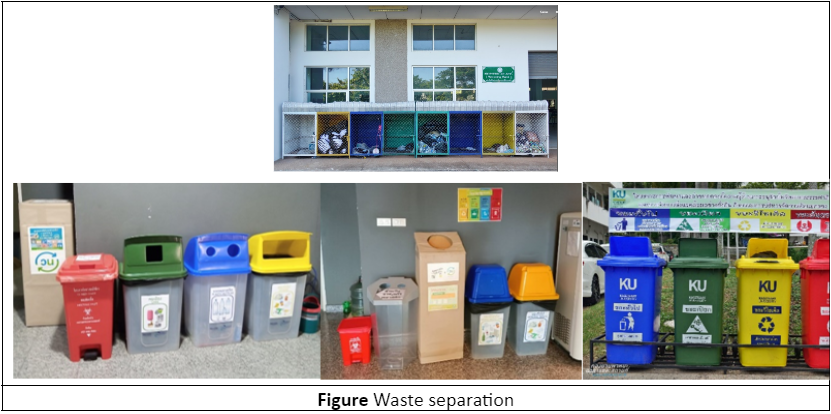
Kasetsart University has realized the importance of waste management. Every university campus has a waste separation management system. The university encourages students and personnel to sort the waste into the right type for easier management.

The Waste Bank Project
The Waste Bank Project is a form of operation to promote solid waste segregation for students and university personnel to understand how to separate solid waste, as well as to create awareness among students and personnel in the university to separate waste at the source, create a solid waste recall mechanism to reduce the amount of solid waste that must be taken to landfill, and have also created separate bins to be used in the purchase of bins.
Waste Management Process
- Collect waste from buildings and different points in the university by placing bins for students and personnel to separate according to the type of waste.
- Sort waste
– Recycling waste
– Organic waste is sent to the nursery for composting and fertilizing the trees within the university.
– General solid waste from the university will be disposed of by the BMA, and the campus will be sent to the municipality for disposal.
- The amount of each type of waste is recorded according to the office building for comparison during the year.

Kaset Fair 2022
The Kaset Fair is an annual event organized by Kasetsart University to help vendors and farmers to provide distribution channels, resulting in a large amount of waste. Since the past few years, the university has set up waste sorting kiosks, but students have advised visitors to the Kaset Fair. But in 2022, there was COVID-19. As a result, it must be adjusted to a waste sorting point manually.

2. The magic eye bins
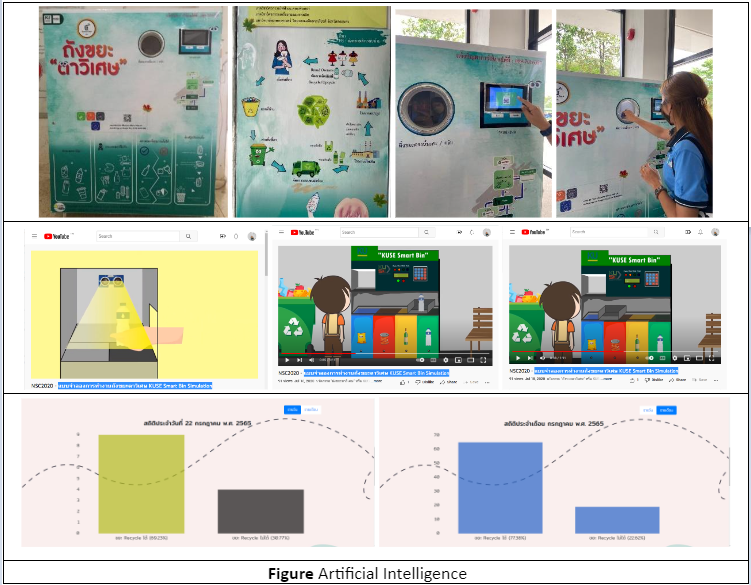 The magic eye bins are created with artificial intelligence (AI) technology, just put the garbage piece by piece into the trash cans, and the bins will sort the trash into the right bins, which will earn points to redeem the university activity hours. Some discarded waste can also be recycled into circulation, such as plastic water bottles, Coke cans, glass bottles, milk bottles/cartons. If we help each other separate these wastes before they are disposed of, it will help preserve the Earth’s environment. Students, professors, and researchers see that most people want to separate garbage and want to save the planet, but they don’t know how to separate waste. Therefore, KUSE Startup has jointly developed magic eye bins that use AI technology to help sort waste types automatically for students, staff and individuals to use within Kasetsart University, Chalermprakiat Campus, Sakon Nakhon Province, where members can download and install mobile applications.
https://www.youtube.com/watch?v=947V38J9BGs
3. CIRCULAR MARK, CIRCULAR ECONOMY IN ACTION
 VGREEN Kasetsart University joins hands with the Thai Environment Institute (TEI) together with its partner agencies, to make history for Thailand in developing the first environmental label for ‘CIRCULAR MARK’ renewable products in the VGREEN world. The Center of Specialization in EnvironmentalLy Friendly Business Strategy, Faculty of Environment, Kasetsart University held a press conference to launch CIRCULAR MARK, CIRCULAR ECONOMY IN ACTION. At the event, there was a signing ceremony for academic cooperation in the development of CIRCULAR MARK as a national standard and certification system to establish credibility and recognition at home and abroad. CIRCULAR MARK labeling products can meet the trend of consumers or green line buyers looking for environmentally friendly products, as the product indicates.
- It is a renewable product.
- There are product designs and packaging that take into account the turnover of materials.
- Have an environmentally friendly production process
- Have a circular economy management system
- Proper product usage instructions are provided to extend the service life as long as possible.
6. There are instructions for sorting waste as well as collecting waste for recycling.
4. Sustainability Expo 2022 : PackBack Project towards EPR Packaging
 The Faculty of Environment, Kasetsart University, is one of 72 leading organizations supporting the PackBack Project to drive packaging management policy in accordance with the concept of circular economy with extended producer responsibility (EPR) principles.
The Faculty of Environment, The Student Affairs Committee, and the Bangkhen Kamphaeng Saen Waste Bank Project under the Faculty of Environment Student Club, together with Thai Beverage and all related organizations, participated in waste sorting activities and provided waste sorting advice to visitors at Sustainability Expo 2022 from September 24 to October 2, 2022. This activity was attended by approximately 300 students, giving advice on waste separation at 14 waste sorting stations and in Planet kids zone. This activity can reuse large amounts of waste, reduce waste disposal at landfills, and also promote waste sorting for visitors to take back to their homes.
5. Recycling
Recycling is the conversion of used materials. The university has a policy to encourage students and personnel to use natural resources cost-effectively and sustainably so that they can be reused again. Upcycling is the creative development of scrap materials, the transformation process of waste materials, or the turning of materials or products that cannot perform their original function into new, higher-quality, cost-effective, environmentally friendly products. Upcycling is a resource-efficient process by transforming waste materials into new products with both design and commercial value, which is part of the drive for product creation. It is environmentally friendly and takes into account social responsibility. Faculty of Architecture, Kasetsart University has a team of designers in AKU Upcycling that will develop discarded items to be reused to add beauty and add new ideas to be reused again.

Teaching and learning in the Recycling Technology course of students in environmental science and technology has set the challenge for students to use used tires to add value. The students created a utility seat in front of building 26, Faculty of Science, Sriracha, which can be used as a model for the use of waste items.


Nowadays, modular wooden house construction is becoming popular because it can be assembled into a variety of shapes, thus leaving little scrap material, eliminating the need for additional trimming, resulting in greater speed and economy in construction. OSB wood house building is convenient, easy to manufacture, completed within 1 month, which can meet the needs of consumers and has a minimum service life of 15 years. For more information, please contact Assoc. Prof. Songklod Jarusombuti, Faculty of Forestry, Kasetsart University. https://www.youtube.com/watch?v=OjFo152ydM0

Faculty of Fisheries, Kasetsart University There is a shop similar to ChobPlaChum. seafood restaurant both fresh and processed, as well as ready-to-eat food and a small coffee corner where residents of Kasetsart University can sit and sip tea and coffee and is a co-working for students and the general public. ChobPlaChum Restaurant, Faculty of Fisheries, also has another highlight. The furniture in the shop is 100% Recyle which has a pavilion structure, which Upcycling plastic chairs Recycle from the pavilion structure PTTGC, the bright pink wall structure of the Waste Side Story Pavilion, one of the interesting works of Bangkok Design Week 2018 which made from recycled plastic And after the exhibition was finished, the parts were redesigned again. until becoming a chair that is durable.

6. The process of developing creative products from scrap materials and upcycle environmental certification systems
 The use of agricultural waste such as hemp core to produce hempboards furniture that are beautiful and has a unique pattern, can be produced for home walls, tables and other materials. They are durable, lightweight, good adhesion, water resistance, sound absorption and has insulation properties, formaldehyde free which brings the sheet pressed from the hemp core can be used as a replacement for cement board or can gypsum board. Research results by Assoc. Prof. Songklod Jarusombat and the research team from Department of Forest Products, Faculty of Forestry, Kasetsart University.
Switching to cloth bags is an easy start for an eco-friendly lifestyle or turning to new products made from waste. Bags from ‘Dialysis Bags’ Innovative. There are only 30 million bags of waste left in Thailand. Assoc. Prof. Dr. Singh Intrachuto, Lecturer of the Department of Building Innovation, Faculty of Architecture, Kasetsart University, the architect, took ‘Dialysis Bags’ through the upcycling process to turn leftovers back into fashion as an item that is not only good for an eye-catching design that is nice to use, but also saves the world. Cutting and extruding the dialysis bags is a career building for the unemployed and the elderly in the Din Daeng 1 Housing Community.
7. Model Person Scrap Lab Developer
 Associate Professor Dr. Singh Intrachooto the Head of the Advisory Board of the Center for Sustainable Research and Innovation (RISC), Faculty of Architecture, Kasetsart University, has been awarded the ‘Environmental Science and Sustainability’ Mahidol Science Environment & Sustainability Award 2022. Awarded in the category of Scrap Lab Developer Model, Waste Materials Design Practice Center, Faculty of Architecture, Kasetsart University, which is one of the first agencies in the world to focus on creating knowledge and driving upcycle innovation. Upcycle is a base for the Circular Economy by bringing waste generated from construction from industrial production and from communities and healthcare facilities through research and teaching to develop value through the upcycling process, and to further develop the research and prototypes of upcycles of the Operation Center and the Research Center to practical use in architecture and construction, as well as to educate from research and innovations that have been developed for the wider society and organizations, aimed at upgrading the construction industry to sustainability by integrating science and the arts. The Mahidol Science Environment & Sustainability Award 2022 is an honorary award given to organizations and individuals who have made outstanding contributions to environmental science by using their scientific knowledge to conserve the environment sustainably, socially responsible, exemplify and inspire society to be publicly recognized and recognized nationally.
8. UHT Recyclable Boxes
 Currently, UHT boxes, which are packaged from the production of sterile systems. It is gaining high popularity among consumers as the UHT system meets the needs of producers and consumers with the ability to maintain the quality of goods for a long time without preservatives. UHT boxes are also packaging where consumers can show their contribution to environmental conservation. It helps sort it out to deliver recycling processes to reduce pollution to society and the environment. The ‘Recyclable UHT Boxes’ project is a project that has been created to enhance knowledge and understanding of UHT boxes and processes. Recycling of used UHT box packaging to reduce waste and increase recycling rates, sponsored and implemented by Tetra Pak (Thailand) Co., Ltd., SIG Combibloc Department of Environmental Quality Promotion, Beverage Box Recycling Center by Fiberpat Co., Ltd. and Social and Environmental Activities Group, Kiong Wlses (Kiong Wlses Company Limited)
The goal is to bring UHT boxes collected from all project network partners into the recycling process to produce the pulp that has been produced into paper to be given to visually impaired schoolchildren. The School for the Blind is the best use of UHT boxes for the purpose of giving back to society. This is the result of good and efficient environmental management. It also creates a good management system that can support the sorting of UHT boxes continuously, leading to sustainable social and environmental care.
9. Won Tank
 Kasetsart University has joined as part of the “Won” project. The “Magic Hand x Won” project was initiated by the cooperation of the government, private sector, and civil society to manage plastic and waste in a sustainable manner or Thailand Public-Private Partnership for Plastic and Waste Management (PPP Plastics). This project has joined forces with the “Won” project to manage plastic waste in a sustainable way by setting up a place to place “cycle bags” for students, personnel, and the public to dispose of all 12 types of clean plastic bags and packaging that are specified. The project will accept donations of bags and packaging, clean plastic film such as diaper bags, plastic water bottle film, or protective film that come with online products before being recycled into plastic pellets for use in the production of shopping bags, and other plastic products to be recycled into bags from recycled plastic pellets again. In addition, plastic bags and film packaging that are donated will be worth 5 baht per kilogram. The project will be donated to the Rare Marine Animal Rescue Center for further use in the rescue missions for injured marine animals.
10. Sustainable Development Goals Project Contest (SDGs) under the topic “Happy & Low-Carbon KU” for the year 2022
Kasetsart University invited students (Undergraduate), faculty members, and personnel submitting Sustainable Development Goals Project Contest (SDGs) under the topic “Happy & Low-Carbon KU” for the year 2022 to win a plaque of honor and a total prize money of 94,000. baht,
divided into 5 fields, consisting of
- Happy University @KU
- Low – carbon for Safe Mobility & Transportation , Alternative Energy
- Low – carbon for Good Health & society , Friendly Environment
- Low – carbon for Sustainable Education & Tourism
- Low – carbon for Creative Food & Agriculture


